My brother Walt owned a company called Angry Auto Group in Minot, ND. The business was a passion project that most people would not understand. Walt had a passion for old cars and trucks. Many, many antique cars and trucks can be found on the old farms and ranches in North Dakota and Montana. Unfortunately, most of these old vehicles go to the scrapper and are crushed. It is a shame. Walt began purchasing as many as he could afford. Most of the vehicles he purchased were beyond the point of no return for highway use. However, every one of them had parts that could be used to keep others on the road. He quickly filled a warehouse full of parts and started a website that gained a worldwide following. Soon customers were calling and emailing from all around the globe. He had customers in India, Russia, New Zealand, Sweeden, Switzerland, and even Cuba. Walt attended farm auctions and met many colorful characters in his quest to save every old car or pickup he could afford. He also encountered some very rare vehicles and antiques. Here is a story in his words about one such antique that is now in my possession.
About the end of April 2021, a friend of mine, Dick, asked if I could help him haul some cars that he bought on a farm about an hour from my shop. This also came with an opportunity to buy some parts cars for myself. Whatever wasn’t bought and hauled away was going to be crushed, and honestly, at this point there were probably quite a few that had already been crushed as there were areas where I could tell cars that had sat there for years were missing.
We made a few trips, and Dick made loading everything easy because he brought his big Bobcat with forks out. He bought several good Model A Coupes, along with some 2 & 4 doors. He also picked up a three door International pickup. What we didn’t know at the time was that it was actually a ‘57 Travelette and only one of about twenty built by International in 1957-58.
Anyway, mixed in there, we loaded a few cars and trucks for me. One was a crusty 1951-52 4 door Plymouth, either a Cambridge or Cranbrook. (They’re about the same). As we put this one on the back of my long trailer the trunk lid popped open. So, as I was strapping everything down, I looked inside and to my surprise there were maybe 30-40 old (very heavy) starters and generators from various vehicles. They don’t make them like they did back then because these all bring at least $25 each in scrap even on a bad day. As I put a strap across the truck lid to hold it down I remember thinking that there was enough scrap in this trunk alone to pay for most of the vehicles I just bought.
Shortly after, I took off for home. There was about 5-7 miles of rough gravel road, followed by 45 miles of highway. As I turned into my shop an hour later, I crossed the railroad tracks and on instinct checked my mirrors to make sure everything was still on the trailer. To my surprise I just caught the flash of something rolling off the back corner of the trailer. I was barely moving anyway, so I came to a stop and walked back to see what was going on. I wasn’t really in the habit of losing things going down the highway but here I was…. Looking at one of those big old starters laying in the driveway. I thought that was strange so I took the strap off the trunk lid on that old Plymouth. As I climbed up to look inside my heart sank. The whole bottom had dropped out of the trunk, and I realized that I had probably dropped thirty of those heavy starters and generators along the highway. CRAP, CRAP, CRAP I yelled inside my head.
Now, completely disgusted, I dropped the cars off in the lineup down in the field to await their turn to be parted out. Honestly, this was the last I thought about this car for almost a year.
March 2022: The snow drifts were starting to melt and the cars in the field were appearing again. I was beginning to get out and make plans for which cars would be next to come into the shop. So, I drove out into the field looking through different cars and trucks to see if there were any treasures I had missed when I brought them in, when I opened the trunk to that old Plymouth from last year. I was quickly reminded of my loss, but to my surprise there was still some good scrap tucked up along each side of the trunk. What the heck I thought, and I reached in and started pulling some out and carrying it over to my truck. Then when I was almost finished, I pulled out this old one-cylinder engine. It was completely covered in oil and dirt and really didn’t look like much. I thought what the heck, if nothing else, I’m going to clean this up and take it home to decorate my living room. (My whole house was already full of car art anyway)
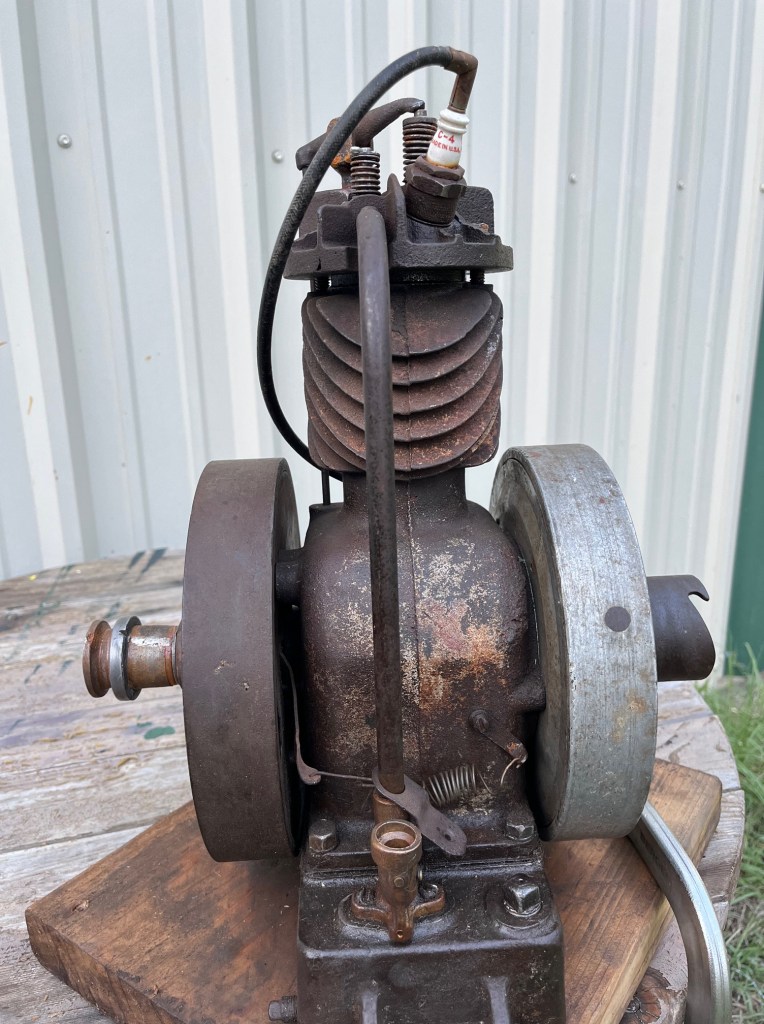
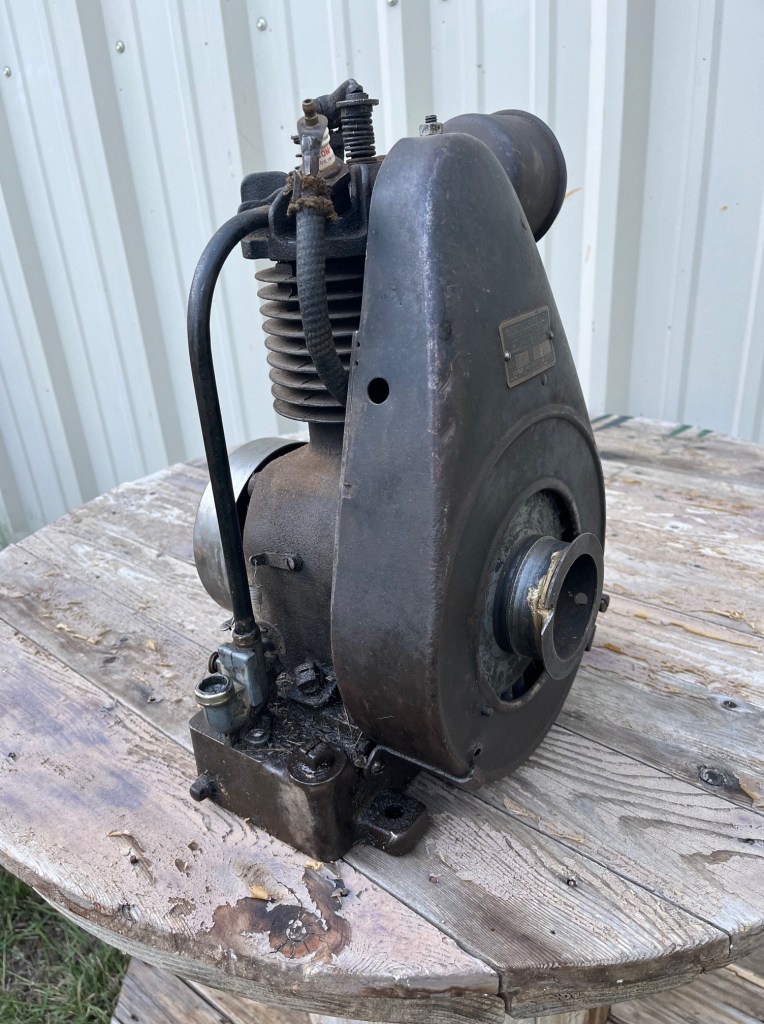
After a bunch of cleaning, much inspection and a lot of research, I figured I had something special. This was a Briggs & Stratton model FB engine. I couldn’t see the serial number until later because it is behind the flywheel, but I knew it was an early Briggs.
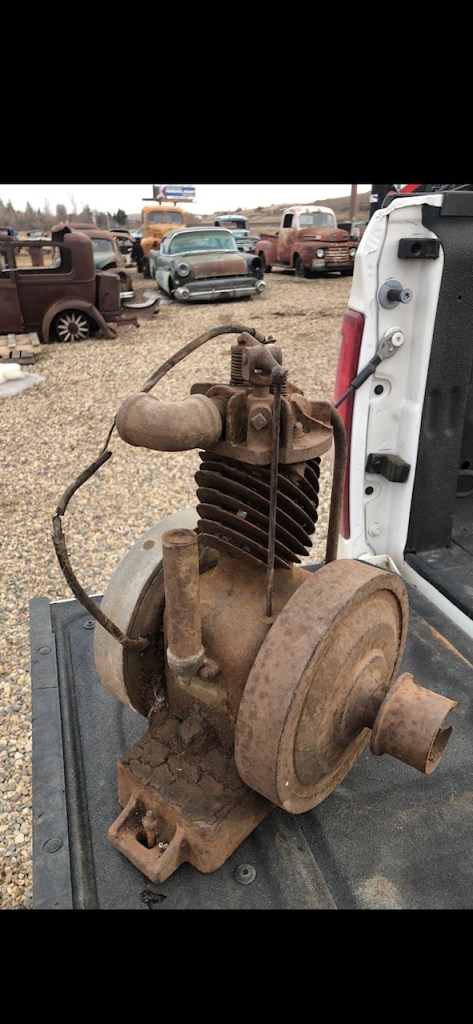
Briggs had made their first 500 engines (the model S) for their little cars, which looked like today’s version of a wooden go-cart. These didn’t hold up too well and the cars were not a success. In about 1921, they came out with the stand alone, one cylinder model F engine. These were used to run just about anything on a farm like small water pumps, generators, or tools in the shop. Very quickly Briggs made some changes and came out with the model FB, which is the one I had just pulled out of a rusted-out trunk of a 1951 Plymouth that was one day away from being crushed and ground up into little pellets just to be shipped off to come back to life as a Toyota. (The ultimate sin)
There’s very few of these engines left out there today. I only found a couple pictures of FB engines and still haven’t seen an actual F. There’s a few more FCs and likely even more as the models progressed.
There were some old guys who would come by the shop from time to time to hang out and see what kind of cool stuff I brought in lately. I rarely disappointed anyone. I knew my friend Dave would like to see this before I took it home and let it get lost in my collection, so I called him up and said I had something he needed to see.
Dave came right out within minutes and was amazed. He checked it over and even though the engine wasn’t completely free, he said, “I know I can make this run again”. I hadn’t even dreamed we would get it running. I figured something must be wrong with it to be stuck in that trunk under all those starters. Dave convinced me that barring anything major being wrong, he would be able to make it run. So, with the little Briggs & Stratton tucked under his arm he headed out of the shop to go work on his newest project.
About two weeks later Dave called me and said I better come over to his place. I kind of knew what that meant, and I was excited.
When I walked into his garage, I was shocked. The engine was all cleaned up and really looked nothing like the old thing that left my shop, even though I had spent a lot of time cleaning it.
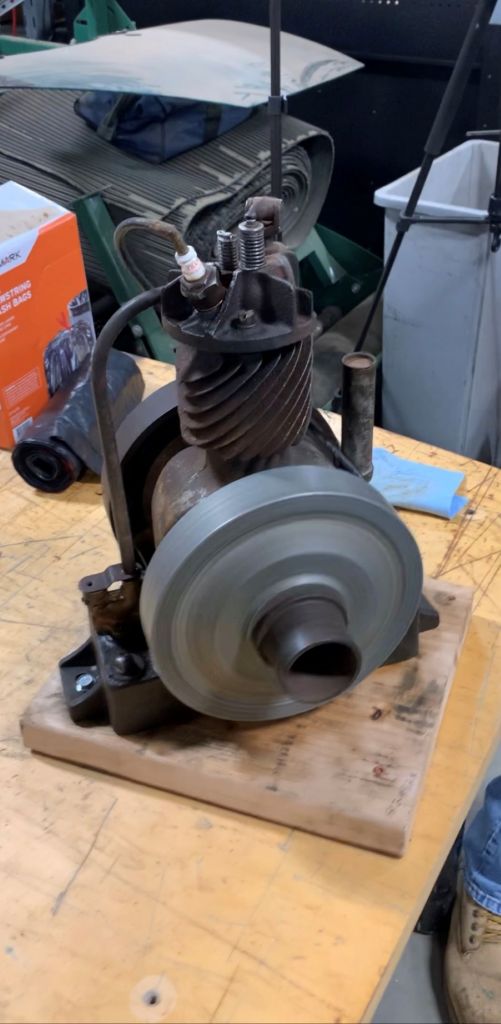
Dave had the biggest grin. “It runs”, he said. He hooked drill to one side and used that to crank it over. After just a couple rotations it popped off and settled into a nice little idle. We just stood there in amazement. It was so cool.
During the tear down Dave could see the serial number was 2,492. In my research I found that Briggs & Stratton started their serial numbers over with the model F and ran them consecutively for the F series engines. So, in essence, this little engine is very close to the beginning of what’s been a very successful run for Briggs & Stratton.
Walt decided to trade the Briggs and Stratton model FB to a customer named Dick Johnson, not the Dick from earlier in the story. In trade, Walt received several parts cars worth several thousand dollars once parted out. At the time, both parties were very pleased with their new acquisitions.
However, due to ongoing health issues that sidelined Walt for more than six months he had to shut down Angry Auto Group. It was an extremely difficult decision. The business was his passion. Walt kept a few treasures from the shop and moved to Montana. But that little Briggs engine never left his thoughts.
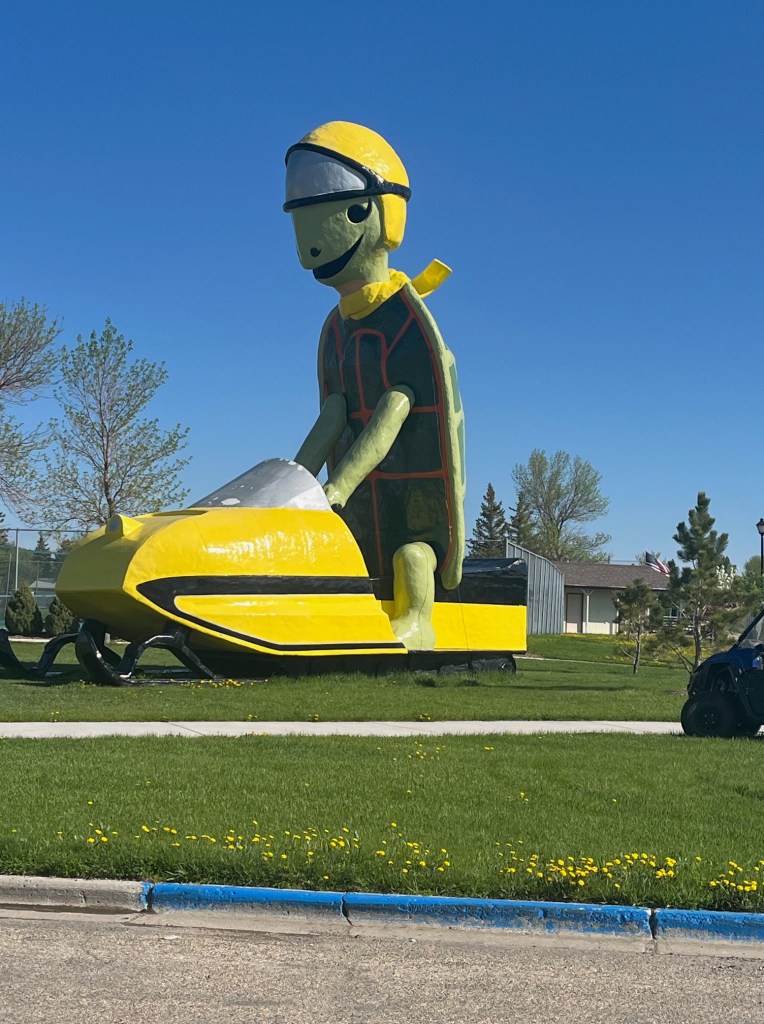
In May of 2024, I flew to Montana to hang out with Walt for a week. We took a road trip to North Dakota to see some of his friends and check in on the little antique engine. We drove to Dick’s farm located 5 miles from Canada. On the way, we had to stop by the world’s largest turtle riding a snowmobile.
Dick’s farm is a beautiful place nestled in the Turtle Mountains. These so called “mountains” are more like hills, but that isn’t important. His house is a true log house that he built himself in 1978 from five semi-truck loads of logs. It sits up on the side of a hill in a small clearing. Down the driveway and across a gravel road is a 100-acre lake. The view of the lake from the porch is amazing. A flock of geese could be seen casually swimming along the shore. Occasionally one would disappear headfirst under the water looking for a meal. A building full of antique cars, tractors, engines, and even a disassembled airplane stands nearby. We spent several hours looking at cars and hearing a story about each one. Dick is a man of many talents. He was a farmer by trade. He also had a bulldozer service clearing land in the area. The long winters allowed for many hours of tinkering on cars. Dick traded for many old relics over the years and has a well-organized “junkyard” nearby. He gave us a tour and once again, every vehicle had a story. We returned to his house where his wife had made us some sandwiches and iced tea. The inside of his log house looked like it belonged in a movie. Dick and his wife are also musicians. They play in a country band doing local gigs around North Dakota.
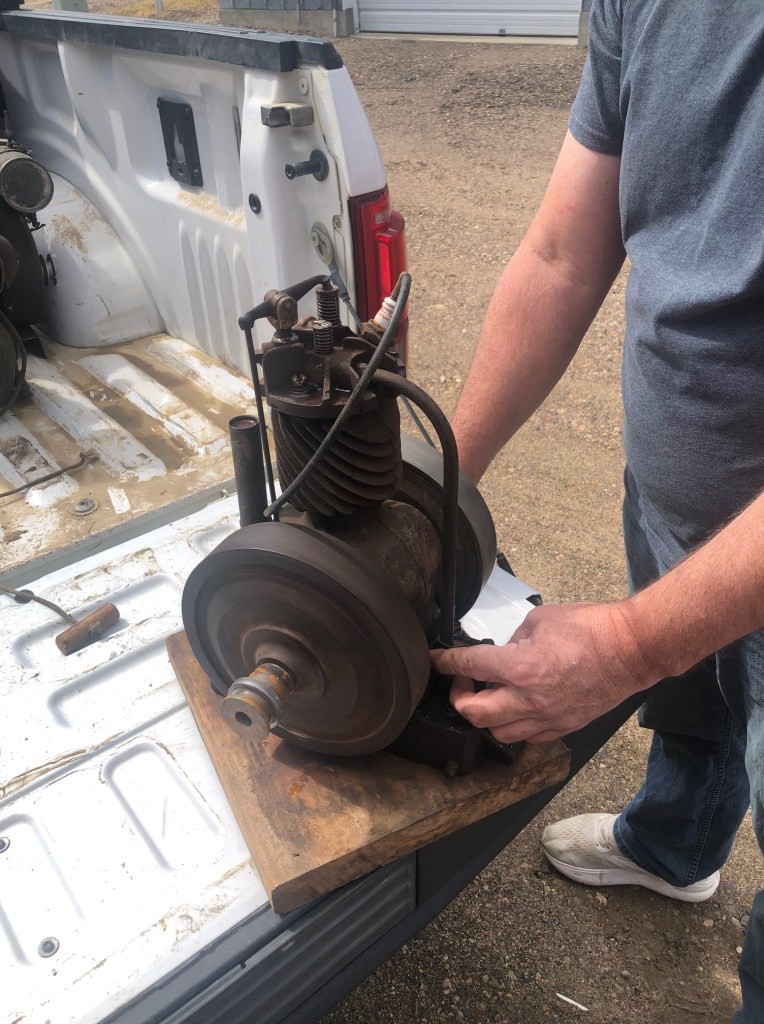
After visiting in the house for a while, we returned to the driveway where Dick’s pickup was parked. In the bed sat the 1922 Briggs and Stratton model FB. Walt had talked to Dick a few weeks prior and asked if he could buy the little engine back. An agreement was made, and cash was exchanged. After another hour or so of storytelling Walt and I headed south to Minot. Dick Johnson is a great guy, and I look forward to our next visit.
The next day, we left Minot to go back to Montana. We zig zagged southwest to the town of Hazen. I lost count of the nuclear missile sights we passed at 13. Walt had been talking to a man on Facebook about some old steel wheels he was selling. Walt’s girlfriend wanted a few for decoration. The seller was not available to meet us, but his friend Carl from down the street agreed to help us.
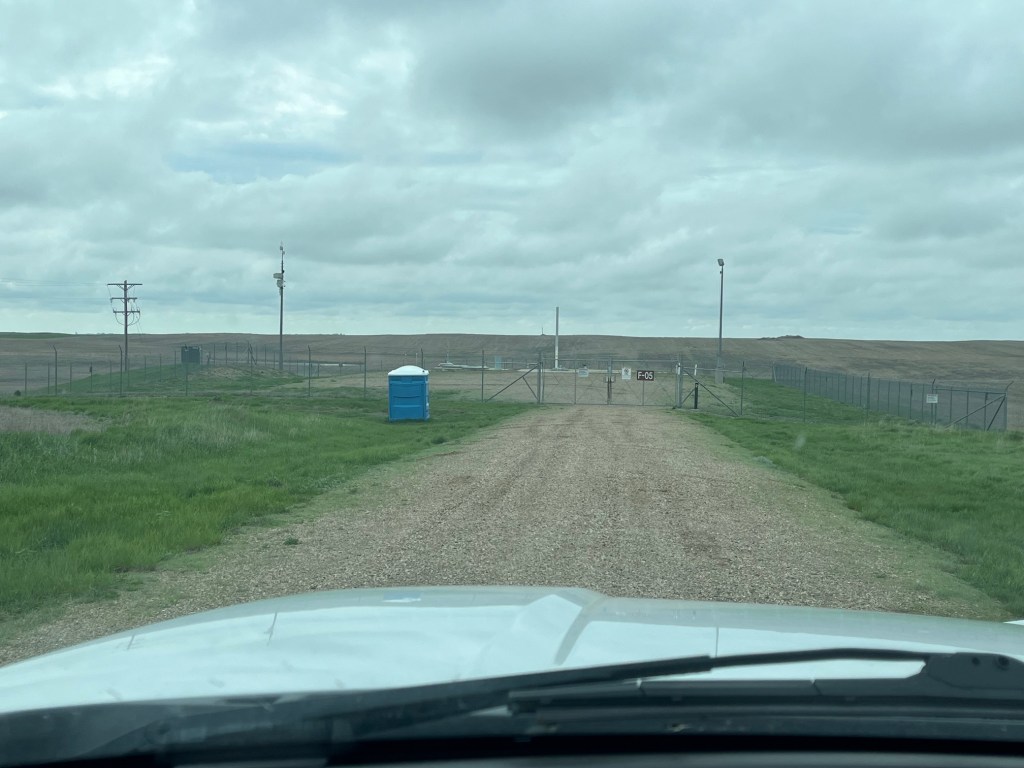
Nuclear Missile Site right off the road.
Carl was waiting for us when we arrived. He was driving a nicely restored baby blue mid 60’s Ford F100. I could tell immediately we would get along. He was dressed in bib overalls sporting a large beard. He was a blue-collar worker like us, and he liked tinkering on anything with an engine or wheels. The wheels were all lined up by price in the side yard. After a few minutes of browsing, Walt picked out the ones he wanted, and Carl collected the cash for his friend.
I began to carry our new treasures to the pickup as Walt started to tell Carl about the other treasure we had collected the day before. Carl took one look at the 1922 Briggs and Stratton engine and calmly said “I have one of those”. We thought we had an extremely rare engine and Carl, while polite, was not in awe. We proceeded to swap a few stories about old cars and our affection for them when Carl invited us over to his house.
Walt and I were not in a hurry, so we followed our new friend Carl to his house a few blocks away. As we pulled up, I knew instantly that Carl was a dying breed of a man. On the street in front of his house was an old unrestored International truck with a homemade rollback flatbed on it. In the yard in front of the garage sat a restored green and black 1925 Chevrolet pickup with a 1950’s era riding lawn mower in the bed. An old David Bradly garden tractor sat on the edge of the yard. On the wall of the garage hung a very ominous rusty bear trap. Carl slid the barn door type garage doors open to reveal more treasures. A restored 1917 Ford Model T Coupe sat on the left side of garage. On the right side of the garage sat a restored 1956 Plymouth Suburban. Yes, Plymouth made a model of station wagon they called a Suburban. Both side walls and the back wall of the garage contained a work bench the entire length. Under the work bench and on top of the work bench was crammed full of antique stationary engines of varying sizes. One was a fully functional steam engine that Carl could run on compressed air, which he later demonstrated for us. And back in the right corner sat a Briggs and Stratton Model FH. It was a little newer than the FB we bought the day before, but still really cool none-the-less. I asked Carl if it ran and he immediately responded with “Of course, everything here runs!”
The Plymouth was in the way of us accessing the old Briggs, so Carl climbed in and fired the car up. The engine purred like a kitten! It sounded really good. With a little jockeying back and forth, we helped guide Carl out of the garage. With the car moved, we discovered even more treasures in the back of the garage. Everywhere I looked there was something cool. Some old John Deere engines, old saw blades and antique tools hanging on the wall, the old steam engine, and the Briggs and Stratton Model FH.
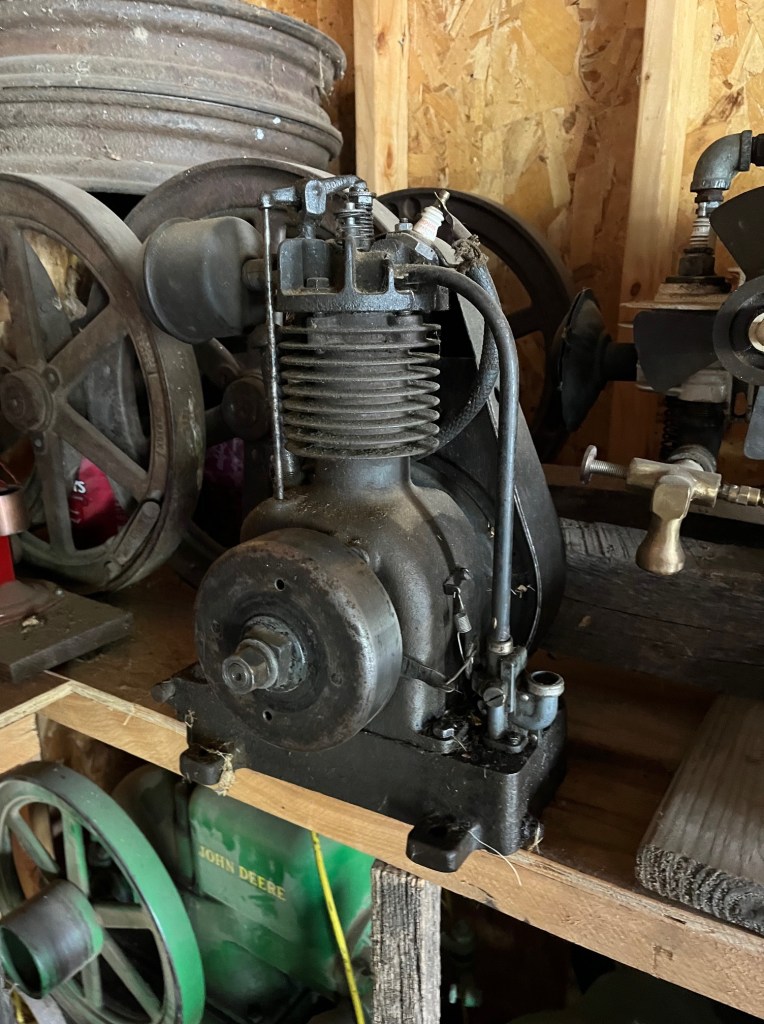
We stood around and listened as Carl told us story after story about everything in the garage. He was obviously enjoying sharing his passion with two guys that genuinely appreciated all the hard work and dedication it took to fix up and restore all these engines and vehicles and keep them running. Carl then opened a gate to a lean-to next to the garage revealing several more stationary engines. One of them was quite large. Of course, they all could be started. Carl would load them all up on the old International and take them to shows occasionally.
After an hour or so, Walt asked if the little Briggs could be purchased. Carl had never thought about selling it but said that for the right price he could be persuaded. Walt made an offer, and I think Carl was a little shocked. He immediately accepted the offer, and handshakes were made all around. Carl was happy, and we were happy to be taking home another piece of history.
After spending another hour listening to stories and meeting Carl’s mail-order-bride from the Philippines, we climbed back into the pickup and headed west through the North Dakota countryside. The spring rains had brought life to the grass and trees. Farmers were busily working their fields planting wheat in between the spring showers. We arrived back in eastern Montana safely. Walt was exhausted from the two days of travel. His health was not good, and he had over done it for the last few days.
I returned to Texas a few days later. We started the Model FB while I was there, but we never tried to start the Model FH. Carl assured us it ran, but we didn’t know for sure. I conducted some research and learned Briggs and Stratton made the Model FH from 1926 to 1933. Our new engine’s serial number is 48,132. I am not sure what year exactly it was manufactured, but it is nearly 100 years old!
Fast forward a few months and my mother returned to Texas after visiting Walt. In the back of her car were two presents Walt sent me. The two Briggs and Stratton engines came to Texas. The model FB fired right up when I tried it. After playing around with it for a bit, I moved on to the model FH.
I started checking out the FH before attempting to start it. The oil in the crank case appeared pretty clean. I rinsed out the gas tank with fresh gas and refilled it. I found the spark plug emitted a nice strong bright blue spark. I managed to check it without shocking myself. Thankfully, I had a special pair of pliers in my toolbox my dad left me just for this occasion. I wound the old starter rope around the starter pully and gave it a pull. The little engine showed signs of life, but did not start. I tinkered with the carburetor a little during subsequent attempts to start it. And finally, after about a dozen attempts the little engine fired up. It ran so smooth. I stepped back and admired the little engine. It is nearly 100 years old and still runs! I immediately took a video and sent it to Walt. I wish he could have seen it run in person. And I wish my father was here to see both of these little engines ru
I don’t know what task these two little engines performed in their former life, but they will be retired to a shelf in my shop. Occasionally, they will be started and tinkered with and put back up on the shelf. I also want to display them at a few antique tractor or car shows. I am glad these two engines were saved from the scrapper. Rest assured; these engines are in good hands.
 Longview Ramblings
Leave a Reply +