My eighth day in Baja was another beautiful day. The temperature was a bit chilly in the morning, but once the sun burned off the marine layer clouds it warmed up nicely.
Eric wanted to pre-run his section again. I wanted to pre-run my section again also, but with the lack of gas in that part of the course, I decided against it. Charlie needed to pre-run the start of the course which was now open for pre-running. The start of the course runs through some of Ensenada’s barrios up on the mountain. And to keep peace with the locals, it is not open for pre-running until a couple of days before the race.
Charlie headed out to pre-run since he could ride to the start just a few blocks from the hotel. Eric loaded his bike into my pickup, and I gave him a ride out to San Matais pass where he could join the racecourse as it headed up into the mountains around Mike’s Sky Ranch.
After dropping Eric off, I made my way to the town of Valle de la Trinidad. It was commonly known to the racers as “Valley T”. It is a quaint town nestled against the hills on the northwest edge of a fertile valley. Farms and ranches are accessed from the highway by driving through town. The only paved street is the main highway access. And only about a quarter mile of it is paved. Often the races run right down the main street, mere feet from the houses. The residents don’t seem to mind and line the streets to cheer on their favorite racer as they blast down their streets at race speed. Valley T is also a favorite place for teams to set up pit stops when the course goes through town.
This year the course stays out of town by about 5 miles. I waited about 4 hours at a gas station at the main road for Eric to arrive. The last 35 miles of Eric’s section was on a road he knew very well and didn’t need to pre-run again. After grabbing some great tacos Valley T is known for, we headed back into Ensenada.
Later that evening we wanted to test out the lights for the race bike. The two large lights mounted to a bracket that was added to the frame. Many teams started using HID style lights which were extremely bright, but Eric and I had previously had issues with that style of light. So, we opted for the more traditional light set up of dual 8” Halogen lights. They were still super bright and not street legal. I joined Charlie with my bike since it also had an off-road light set up. Mike wanted to take a spin on the race bike in the dark so he joined us on his bike.
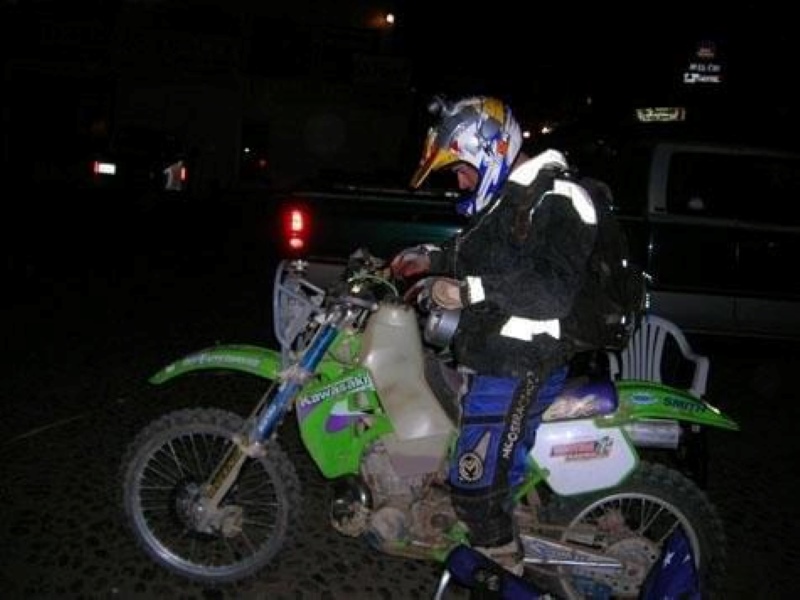
We headed out of town on the racecourse. The race bike lights were functioning quite well, as was mine. Mike’s light was not very bright, so I tried to let him ride beside me as much as possible. As we left town, the bright lights allowed us to cover ground quickly without any danger. Not far into our ride the racecourse climbed a few steep hills that the pre-runners had wreaked havoc on earlier that day. The loose powder-like dirt was difficult to ride in. We decided to turn back because we didn’t need to damage the race bike. However, as we started back to town Charlie realized there was a problem with the race bike.
As hard as he tried, Charlie could not get the clutch to disengage. I messed with the bike a little in the dark to no avail. We carefully made our way back to the hotel. I was perplexed. I had never had this issue with a Honda XR 650 before. I tried adjusting the clutch, but I determined something was broken inside the engine.
My heart sank! We were two days away from racing and our race bike was broken. This is why we usually did not pre-run on the race bike. There was nothing else I could do that evening, so we put the bike away for the night. I went to bed thinking about what the problem could be.
The day before each race SCORE holds what is called “Contingency”. Vendors set up booths in a vacant lot near the starting line, which was right down the street. All the race vehicles would line up and snake very slowly through the maze of vendor booths. Most vehicles are pushed, with much of the team assisting. If a racer is using a particular vendor’s product they can sign up for “contingency”, which is a reward if they do well in the race. Usually, the contingency is product from that company or a discount toward future purchases. Occasionally, a company will offer a cash payout to a racer that wins. Technical inspection is located at the end of the vendor row. Every race vehicle must be inspected for safety. Each driver/rider helmet and the driver’s fire suits are also inspected. Each vehicle must have functioning rear facing lights and a first aid kit. The engines and frames are also marked so they cannot be changed during the race.
Usually, Contingency day is a time to relax a little and prepare for the battle the next day. Unfortunately, that was not the case for us. I dove into the race bike engine as soon as I could. I was familiar with the clutch, as I had replaced a few in a previous race. But I had never gone deeper into this exact engine. It did not take me long to find the problem, however. The “clutch basket”, the piece that holds the clutch plates, had fused with the bushing it rode on. I removed the clutch basket and headed down the street to the San Nicholas Hotel.
The Honda Factory team stayed at the San Nicholas Hotel. Thankfully, the late, Bruce Olgivie was standing in one of the team’s support vans. I had known Bruce for a few years, but I was always intimidated while around him. His racing resume was legendary, with his first win taking place just a couple of months before I was born. Later, he managed Honda’s off-road race program. Unfortunately, Bruce lost his battle with cancer a few years later.
I approached with my bad clutch basket and explained what I had found. He stood there silently nodding his head and finally looked up at me with a slight smile. He motioned for me to step up into the van as he bent down and started digging through some boxes toward the front. After a minute or two he stood up with a clutch basket in his hand. He proceeded to show me how the older XR 650s had a flaw with that exact part. The errant bushing did not allow enough oil flow for lubrication. When the problem was found it was remedied on later models. Bruce had a perfectly good, used, clutch basket he was willing to part with. And for good measure, he threw in a new set of clutch plates and a gasket for the cover.
I must have thanked Bruce a million times as I left. I was relieved and embarrassed at the same time. I was supposed to be the “expert” on this adventure, and I was not aware of this common problem with our race bike. I had been racing them for several years in Baja and had never encountered this before.
I quickly returned to the hotel to install the newly sourced parts. The rest of the team shared my relief as well. While I re-assembled the engine the other guys worked at installing a new set of tires and ultra heavy-duty tubes. Brad and Brent along with their wives had arrived from San Felipe while I was gone, and they jumped in to lend a hand.
When the race bike was fully re-assembled, I took it for a quick test spin down the street. The clutch worked perfectly. Eric gave the bike a quick look over and spotted a few things he wanted to address. He was the most experienced Baja racer on the team. However, his concerns would need to be addressed later as we needed to head to contingency and tech inspection.
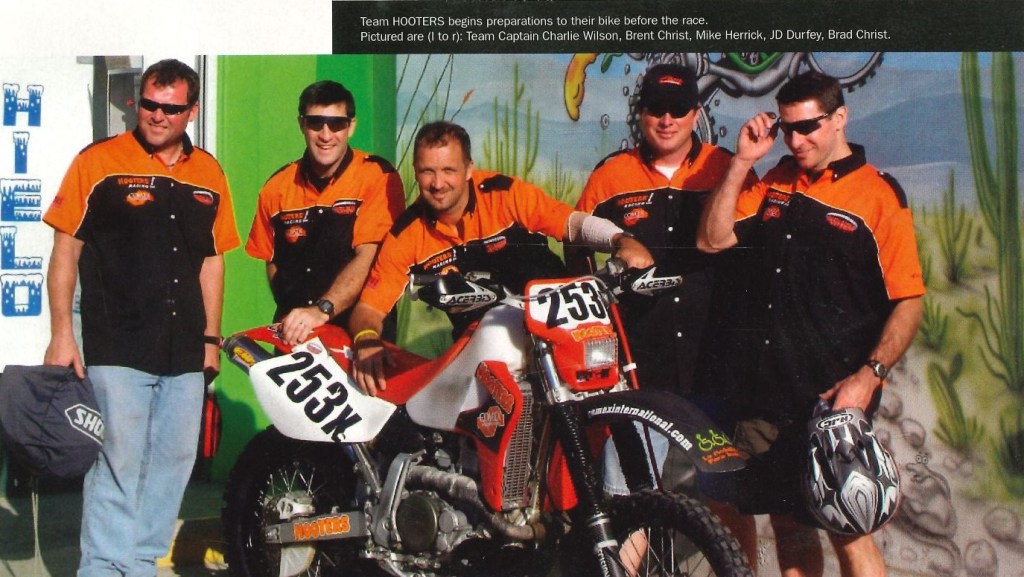
We made our way to contingency and tech as a team through the crowded streets. We wore matching orange and black shirts with “Hooters” embroidered on them. The locals come out in mass for this event, and it turns into a giant street party every time. It was a fun time. We paused briefly for a photo op that would later be used in a magazine article. (I cannot remember why Eric was not in the picture.) Most of the vendors in contingency are geared toward the race cars. So, we snaked through the slow-moving vehicles and crowds of people to the tech inspection area. On the way through contingency, I bummed a cigarette from a stranger and tucked it behind my ear. I didn’t smoke, but I knew someone who did. And I had learned a few years earlier, it was helpful to grease the wheels, so to speak.
Finally, it was our turn to enter the tech inspection area. SCORE technical inspections were led by Red and Art. They were old school racers that had an unparalleled passion for the sport. Red’s name described him well. He was about six foot two inches tall and sported a large bushy light red beard. He always wore a hat with a mane of matching hair protruding under it. Art was a former buggy racer and had been burned and lost part of his arm in an accident years earlier. We always had some good laughs when around them. They would work all day crawling all over race cars and dealing with nervous racers and never run out of jokes. The probably only had half a dozen jokes between them, but since their audience was constantly changing all day, it worked for them.
I handed Red my paperwork for the race bike and the smoke from behind my ear. His eyes lit up and he graciously accepted my peace offering. I was pretty certain there wouldn’t be any issues with our bike or gear, but it never hurt to keep him happy. After a few minutes, Red signed off on our bike and applied stickers to each helmet and one to the bike signifying it was safe to use. If a rider was caught wearing a helmet without a tech sticker he could be disqualified on the spot.
After tech inspection was completed, we made our way to the San Nicholas hotel where race registration was located. We all needed to complete our registration forms and receive our wrist bands. Thankfully, the line was not very long, and we finished quickly. I saw a few guys I knew, and we chatted about the course. They all thought my new sponsor was awesome.
We made our way back to the hotel. The streets were still filled with spectators and racers. It was still light out, but we decided to eat an early dinner as a team. Brad and Brent wanted to drive back to San Felipe that evening. We met at the hotel restaurant and over the course of a great Mexican food dinner I laid out the race day plan, who would go where and how would everyone get there. I also tried to plan for the unforeseeable incidents. I enjoyed this part of my job and tried to think of every possible scenario, especially since most of the team had never done this before. After an excellent dinner, Brad, Brent, and their wives headed out for San Felipe.
Eric, Charlie, Mike, and I looked over the race bike again and addressed a few things Eric pointed out. It was always good to have a second set of eyes to make sure nothing important was overlooked. We had 710 miles of the harshest terrain on earth to tackle the next day and we wanted to have a flawless machine.
The final point of business before the race was the driver’s meeting. We all walked down the street to the convention center. We turned off the street through large rod iron gates and made our way through the beautiful courtyard. The entrance into the building was through another set of tall gates. Inside the cavernous building we made our way down a hallway to a large meeting room already filled with racers and crew members. There were no seats available, so we stood at the back of the room. Soon the pomp and circumstance began led by Sal Fish the owner of SCORE International. The Mexican national anthem was played. Dignitaries and local officials were recognized and thanked for allowing us to race on their roads. Most of the initial ceremony was in Spanish. Once the official business was complete, Sal talked about the racecourse and a few areas of concern. A few people had questions and they were answered. The meeting lasted about an hour.
After the driver’s meeting we walked back to the hotel. Mike headed back to his beach house and soon we retired to our rooms to get some much-needed rest.
 Longview Ramblings
Leave a Reply +